
Most businesses do not struggle because they lack interest. They struggle because interest is not captured, followed up, or turned into sales in a consistent way. Leads come in, then disappear. Messages are sent, then forgotten. Opportunities appear, then fade away.
Have you ever looked at your inbox or WhatsApp and thought, “We should have followed up on this one”? That moment is where many sales are lost.
Automation is not about replacing people. It is about making sure no opportunity is wasted.
What Lead Generation Automation Really Means
At its core, automation is simple. It is a system that helps you respond, follow up, and organize leads without relying fully on manual effort.
Instead of waiting for someone to reply, the system continues the conversation. Instead of forgetting a lead, the system keeps it active. Instead of guessing who to contact next, the system already knows.
Think of it like having a quiet assistant that never sleeps. It does not get tired. It does not forget. It simply keeps things moving.
Why Manual Lead Handling Fails
Many businesses still handle leads manually. A customer sends a message, someone replies when they are free, and follow-ups depend on memory or time.
This creates gaps.
Some leads get fast responses. Others wait hours or days. Some are followed up once. Others are never contacted again.
Now ask yourself this. If a potential customer feels ignored, do they wait or do they move on?
Most move on.
That is where revenue is lost, not because of lack of interest, but because of lack of structure.
Step 1: Capturing Every Lead
The first part of automation is ensuring no lead is lost.
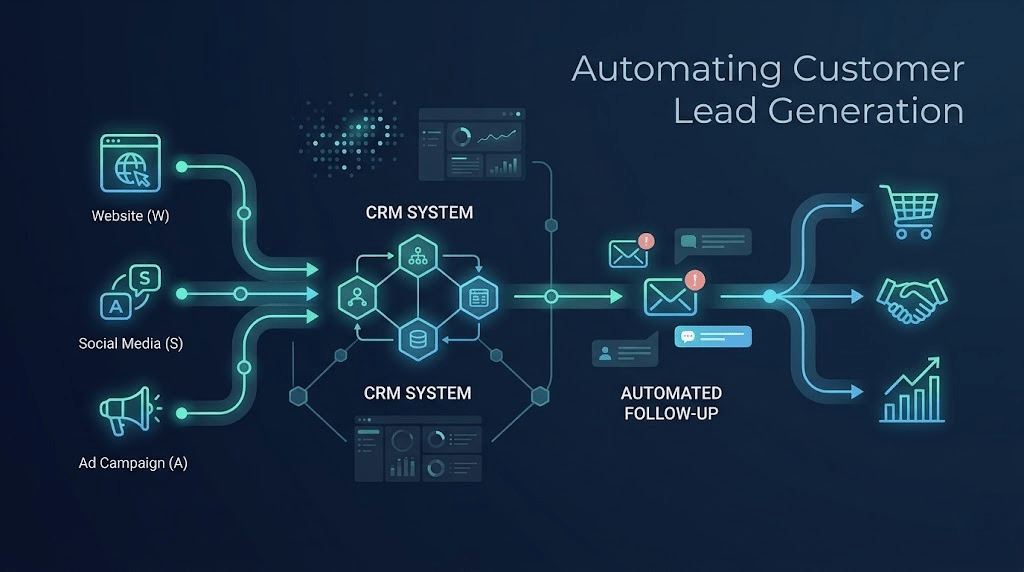
This includes website forms, landing pages, social media messages, ads, and WhatsApp inquiries. Every entry point should feed into one system.
Without this, leads remain scattered. Some in email, some in DMs, some in notebooks, and some forgotten completely.
A proper system brings everything together in one place.
Step 2: Instant Response Systems
Speed matters more than most businesses realize.
When someone shows interest, the first response often determines whether they continue or leave.
Automated responses ensure that every inquiry gets an immediate acknowledgment. Even before a human replies, the customer feels seen.
This simple step builds trust early.
Step 3: Structured Follow-Up
Most sales do not happen on the first interaction. People need reminders, explanations, and reassurance.
Automation allows follow-ups to happen consistently without relying on memory.
Messages can be scheduled through email or WhatsApp so that every lead is nurtured over time.
Not aggressively. Not randomly. But in a structured way that keeps the conversation alive.
Step 4: Organizing Customer Data
When leads are not organized, opportunities become harder to manage.
A CRM system solves this by storing all customer information in one place. Names, contacts, messages, and activity history are all visible.
This makes it easier to understand who is ready, who needs more time, and who has already engaged before.
Instead of guessing, you work with clarity.
Step 5: Reducing Manual Work
A lot of time in business is spent repeating the same tasks. Sending follow-ups. Updating spreadsheets. Checking messages.
Automation removes this repetition.
Once the system is set up, it runs quietly in the background. Your team focuses on meaningful conversations instead of repetitive work.
This does not just save time. It improves focus.
Step 6: Turning Interest into Sales
The goal of automation is not just organization. It is conversion.
When leads are followed up consistently, when responses are fast, and when information is clear, more people make decisions.
Not because they were pushed, but because they were guided properly.
A well designed system does not force sales. It supports decisions.
Why Automation Matters Today
Business today moves fast. Customers expect quick responses. They expect clarity. They expect consistency.
If your system cannot keep up, you lose opportunities without even realizing it.
Automation helps bridge that gap. It ensures that no matter how many inquiries you receive, each one is handled properly.
It creates stability in your sales process.
The Real Impact of Automation
When businesses implement automation properly, something changes.
Response times improve. Follow-ups become consistent. Leads are easier to track. Sales conversations become more structured.
But more importantly, the business stops depending on chance.
Growth becomes more predictable.
Final Thought
Automating customer lead generation is not about removing the human touch. It is about protecting opportunities that would otherwise be lost.
Because at the end of the day, most businesses do not need more leads. They need better systems to handle the leads they already have.
And once that system is in place, everything starts to feel more controlled, more stable, and more intentional.
Growth stops being random. It becomes something you can manage.
